As part of Jagadguru Jayendra Saraswati Swamigal's Avatara Mahotsav held in Shri Kanchi Kamakoti Shankara Matam, Malleshwaram, every year, 10 concerts were held during the Navatri period this year. Following up on the earlier posts covering other concerts, here are the notes of the remaining 4.
The concerts on 6th to 9th days of the Mahotsav featured excellent concerts of Smt Gayatri Venkatraghavan (Friday, 4th Oct), Vidwans Mysore brothers (Saturday, 5th Oct), Shri Abhishek Raghuram (Sunday, 6th Oct) and on Saraswati Poojai evening Shri Rajesh Vaidya (Monday, 7th Oct). Each of these concerts had a unique touch. While the artists in the first two of these concerts asked the audience to suggest the compositions to be rendered, right at the beginning of the concert, the next two concerts seemed like predominantly artist choice.
Smt Gayatri Venkatraghavan began the concert with shlokam in rAgams yamunA kalyANi and nATa, before taking up the nATa kriti pAHimAm shrI rAjarajEshvari set to tisra gati Adi tALam a composition of Shri Shyama Sastri. She then took up Shri Uthukkadu Venkatasubbayyar's navAvarna kriti in kalyANi, vAcasiyadi. A brief AlApanai of kamalAmanOHari by her and Shri C N Chandrasekar was followed by kancadalAyadAkshi composed by Shri Muthuswami Dikshitar. Another of his lilting compositions followed, amba nIlayatAkshi set to nIlAmbari rAgam.
 tAyE tripura sunDari composed by Shri Periyasami Thooran, set to shuddha sAvEri rAgam was followed by an elaborate presentation of bhairavi. The main composition for the day was janani mAmava, which was followed by a compact laya vinyAsam by Delhi Sairam. His accompaniment throughout the evening was in step with the prayerful mood of the concert. Then there was a flurry of small kritis, per the requests from various rasikas in the audience. nAn oru viLayATTu bommaiyA in navarasakannaDa, kanakashaila viHAri in punnAgavarALi, a tirupugazh on Maha Periyava (vEdam nAnginai kaTRu kodutta) in cencuruTTi followed by tUmani mADattu in HamIr kalyANi were soulful renditions. The concert was closed by brisk rendition of tiruppugazh agaramum Agi in sindhubhairavi and karpagamE in madhyamAvati.
The following day, on the birthday of Shri Mysore Manjunath, the concert of the Mysore brothers Shri Nagaraj and Shri Manjunath was held at the matam. They were accompanied by Shri Thiruvarur Bhaktavatsalam on mridangam and Shri Sundar Kumar on the kanjira. In this concert, they presented the compositions in leisurely manner and gave elaborate treatment for each AlApanai and rendition. We thoroughly enjoyed the 4 pieces played on the day. The concert began with a very sedate Anandabhairavi AlApanai followed by marivErE, a composition of Shri Shyama Sastri. vAcaspati was the second rAgam played by the brothers, and the composition chosen was parAtparA paramEshvarA. The third song of the evening was Maharaja Swathi Tirunal kriti, sArasAksha, after detail delineation of pantuvarALi.
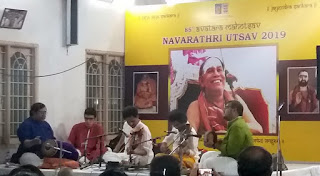 As per audience request, a rAgam tAnam pallavi in beHAg was played by the Mysore brothers, with the pallavi line being dEvi shrI tripura sundari kAmAkshi, set to Adi tAlam. Very traditional touches were played, as well as some Hindustani style sangatis. This was followed by rAgamAlika swarams in kAnaDA, sAvEri, Arabhi, which led on to a flourish of nAgaswaram-concert-like tandem rAgamAlika swarams for 1 avartanam or 1/2 avartanam in a myriad of rAgams. This type of tandem rAgamAlika swarams I have not heard from other instrumentalists, except the nAgaswaram. Rasikas may kindly comment on whether this type of playing rAgamAlika is a regular feature from the Mysore brothers, or others in instrumental concerts.
On 6th October, it was an overflowing hall for Shri Abhishek Raghuram's concert, accompanied by Shri Vittal Ramamurthy (violin), Shri Thiruvarur Bhaktavatsalam (mridangam) and Shri Alathur Rajaganesh (kanjira). The concert started with a sedate shankarAbharanam AlApanai followed by somber rendition of svara rAga sudhA. The second song rendered was sUryamUrtE on the Sunday evening, the navagraHa kriti in sowrAshTram composed by Shri Muthuswami Dikshitar. With a brief and crisp AlApanai in jayantasEna, Shri Abhishek took up vinatAsuta vAHana, a composition of Saint Thyagaraja.
 Shri Abhishek then sang a brief kIravANi followed by the Appar tEvAram 'vAnanai mathi sUDiya' (Thiruvannamalai kshetram), starting off from the second half of the verse. The next song chosen was jAlandara supItastitE, in valaci rAgam, a composition of Shri Harikesanallur Muthaiah Bhagavatar, which was sung from the anupallavi after a brief AlApanai.
The first major elaboration of AlApanai was reserved for dEvagAndhAri. After both the artists had completed the AlApanai, Shri Abhishek took another minute to explore a few phrases in the upper octave as though he felt he had missed it in the initial AlApanai. He took up from the anupallavi of shAradE vINA vAdana, that is, at nArada jananI catur nAyaki, a composition of Shri Papanasam Sivan. This was followed by an excellent laya vinyAsam by Shri Bhaktavatsalam and Shri Rajaganesh, where the mridangist even goaded the other to complete some interesting korvais. At the ending korvai of one exchange Shri Rajaganesh's closure indicated a start of next pattern. Catching the pattern, Shri Bhaktavatsalam asked him to complete it, even if it seemed to extend beyond the usual exchanges.
Following this major item, Shri Abhishek sang two kritis of Shri Muthuswami Dikshitar. A soulful and slow presentation of rEnukAdEvi samrakshitOHam in kannaDa bangALa and bruHadIsvarO rakshatu mAm in gAnasAmavarALi (gAnamUrti). These seemed to indicate that we may have a second major song to follow. He sang a short AlApanai in Anandabhairavi, and then rendered nanganallUr ezhundaruL sarva mangaLE rAjarajEshvari, beginning with the caranam 'un perumaiyonDrum ariyEn', a composition of Shri Papanasam Sivan.
As time seemed to be running out, as it was already 9:10 PM or so (with most concerts ending between 9:10 and 9:30), the artist decided to take up an elaborate AlApanai of kalyANi. So, the lack of tukkadas seemed to rightly indicate that there was more to the concert. And what a kalyANi it was. Both Shri Abhishek and Shri Ramamurthy gave full justice to this majestic rAgam without any glance at the clock. Shri Pallavi Gopala Iyer's nIdu carana pankajamulE was the second elaborate composition of the evening. With the neraval and kalpana svarams, it was a full hour rendition of this piece. Shri Abhishek however indicated to the accompanists half-way through, that this would be the last item for the day. If Shri Rajaganesh did not have to rush to catch a bus / train, there may have been a second laya vinyAsam, as per Shri Abhishek's initial indications. The percussion artists closed the item with a very short kuraippu, following which the mangaLam was sung, well beyond 10 PM! A superb treat for all the rasikas, many of whom stood through a major portion of the concert!
Saraswati poojai evening was graced by a vINai concert, quite appropriate offering to the Goddess of Learning. Shri Rajesh Vaidya was accompanied by percussionists Shri Mohana Ram on mridangam, Shri Praveen Narayanan on the tabla and Shri Sai Hari on the ghatam. This concert was a typical fast paced offering from Shri Rajesh Vaidya, with many of the regular compositions suited for the instrument. He began with obeisance to all Periyavas with endarO maHAnubhAvulu, followed by brisk renditions of nIdaya rAdhA in vasantabhairavi and telisi rAma in pUrnacandrikA. Then came the first AlApanai of amrutavarshini followed by Shri Harikesanallur Muthaiah Bhagavatar's sudhAmayI sudhAnidE.
 He then alternated the brisk manavyAlakim in naLinakAnti, a slow simHendra madhyamam kriti kAmAkshi kAmakOTi (of Shri Muthuswami Dikshitar), and a fast raghuvamsha sudhA in kadanakutUHalam. He next announced he would render a rAgam tAnam pallavi, and the rAgam chosen was pantuvarALi. A brilliant and elaborate rendition, with some gimmicks of playing long sangatis with single hand included, was followed by the pallavi on Mahaperiyava Jagadguru Chandrashekara Swamigal - 'aruL tarum jagadguru candrashEkarA anusham dinattil avadaritta' in Adi tALam. Elaborate kalpanaswarams and a boisterous laya vinyasam by the three percussionists rounded off this RTP. The laya vinyasam also included Shri Rajesh Vaidya's participation with some appropriate strumming at the end of korvais.
The concert rolled forward with several instrumental favorites, like ratipatipriya composition jagatjanani of Shri Ghanam Krishna Iyer, bArO krishnayyA of Shri Purandaradasa in rAgamAlika, bhO shambhO of Guru Dayanand Saraswati in rEvati, venkatAcala nilayam in sindhubhairavi and krishnA nI bEganE in yamunA kalyANi. Shri Rajesh Vaidya rounded off the concert with the wonderful maitrIm bhajata, poem of Mahaperiyava Jagadguru Chandrashekara Swamigal, continuing onto veda chanting phrases and concluding with candrashEkarA IshA in sindhubhairavi.
I have only two concerns about the two instrumental concerts. The addition of technology to provide different effects, with second output directly from the instrument, amplification, etc., were a bit intrusive in this smaller hall. Those may work out to be excellent presentations in bigger auditoriums which have good acoustics. However, these could have been appropriately adjusted for this simple hall of the matam. At times, the sound engineer could not perfectly adjust the artist-provided additional equipment to work along with regular equipment. Loudness, some interferences, etc., caused unnecessary interruptions, which can be avoided.
The concerts on 6th to 9th days of the Mahotsav featured excellent concerts of Smt Gayatri Venkatraghavan (Friday, 4th Oct), Vidwans Mysore brothers (Saturday, 5th Oct), Shri Abhishek Raghuram (Sunday, 6th Oct) and on Saraswati Poojai evening Shri Rajesh Vaidya (Monday, 7th Oct). Each of these concerts had a unique touch. While the artists in the first two of these concerts asked the audience to suggest the compositions to be rendered, right at the beginning of the concert, the next two concerts seemed like predominantly artist choice.
Smt Gayatri Venkatraghavan began the concert with shlokam in rAgams yamunA kalyANi and nATa, before taking up the nATa kriti pAHimAm shrI rAjarajEshvari set to tisra gati Adi tALam a composition of Shri Shyama Sastri. She then took up Shri Uthukkadu Venkatasubbayyar's navAvarna kriti in kalyANi, vAcasiyadi. A brief AlApanai of kamalAmanOHari by her and Shri C N Chandrasekar was followed by kancadalAyadAkshi composed by Shri Muthuswami Dikshitar. Another of his lilting compositions followed, amba nIlayatAkshi set to nIlAmbari rAgam.

The following day, on the birthday of Shri Mysore Manjunath, the concert of the Mysore brothers Shri Nagaraj and Shri Manjunath was held at the matam. They were accompanied by Shri Thiruvarur Bhaktavatsalam on mridangam and Shri Sundar Kumar on the kanjira. In this concert, they presented the compositions in leisurely manner and gave elaborate treatment for each AlApanai and rendition. We thoroughly enjoyed the 4 pieces played on the day. The concert began with a very sedate Anandabhairavi AlApanai followed by marivErE, a composition of Shri Shyama Sastri. vAcaspati was the second rAgam played by the brothers, and the composition chosen was parAtparA paramEshvarA. The third song of the evening was Maharaja Swathi Tirunal kriti, sArasAksha, after detail delineation of pantuvarALi.

On 6th October, it was an overflowing hall for Shri Abhishek Raghuram's concert, accompanied by Shri Vittal Ramamurthy (violin), Shri Thiruvarur Bhaktavatsalam (mridangam) and Shri Alathur Rajaganesh (kanjira). The concert started with a sedate shankarAbharanam AlApanai followed by somber rendition of svara rAga sudhA. The second song rendered was sUryamUrtE on the Sunday evening, the navagraHa kriti in sowrAshTram composed by Shri Muthuswami Dikshitar. With a brief and crisp AlApanai in jayantasEna, Shri Abhishek took up vinatAsuta vAHana, a composition of Saint Thyagaraja.

The first major elaboration of AlApanai was reserved for dEvagAndhAri. After both the artists had completed the AlApanai, Shri Abhishek took another minute to explore a few phrases in the upper octave as though he felt he had missed it in the initial AlApanai. He took up from the anupallavi of shAradE vINA vAdana, that is, at nArada jananI catur nAyaki, a composition of Shri Papanasam Sivan. This was followed by an excellent laya vinyAsam by Shri Bhaktavatsalam and Shri Rajaganesh, where the mridangist even goaded the other to complete some interesting korvais. At the ending korvai of one exchange Shri Rajaganesh's closure indicated a start of next pattern. Catching the pattern, Shri Bhaktavatsalam asked him to complete it, even if it seemed to extend beyond the usual exchanges.
Following this major item, Shri Abhishek sang two kritis of Shri Muthuswami Dikshitar. A soulful and slow presentation of rEnukAdEvi samrakshitOHam in kannaDa bangALa and bruHadIsvarO rakshatu mAm in gAnasAmavarALi (gAnamUrti). These seemed to indicate that we may have a second major song to follow. He sang a short AlApanai in Anandabhairavi, and then rendered nanganallUr ezhundaruL sarva mangaLE rAjarajEshvari, beginning with the caranam 'un perumaiyonDrum ariyEn', a composition of Shri Papanasam Sivan.
As time seemed to be running out, as it was already 9:10 PM or so (with most concerts ending between 9:10 and 9:30), the artist decided to take up an elaborate AlApanai of kalyANi. So, the lack of tukkadas seemed to rightly indicate that there was more to the concert. And what a kalyANi it was. Both Shri Abhishek and Shri Ramamurthy gave full justice to this majestic rAgam without any glance at the clock. Shri Pallavi Gopala Iyer's nIdu carana pankajamulE was the second elaborate composition of the evening. With the neraval and kalpana svarams, it was a full hour rendition of this piece. Shri Abhishek however indicated to the accompanists half-way through, that this would be the last item for the day. If Shri Rajaganesh did not have to rush to catch a bus / train, there may have been a second laya vinyAsam, as per Shri Abhishek's initial indications. The percussion artists closed the item with a very short kuraippu, following which the mangaLam was sung, well beyond 10 PM! A superb treat for all the rasikas, many of whom stood through a major portion of the concert!
Saraswati poojai evening was graced by a vINai concert, quite appropriate offering to the Goddess of Learning. Shri Rajesh Vaidya was accompanied by percussionists Shri Mohana Ram on mridangam, Shri Praveen Narayanan on the tabla and Shri Sai Hari on the ghatam. This concert was a typical fast paced offering from Shri Rajesh Vaidya, with many of the regular compositions suited for the instrument. He began with obeisance to all Periyavas with endarO maHAnubhAvulu, followed by brisk renditions of nIdaya rAdhA in vasantabhairavi and telisi rAma in pUrnacandrikA. Then came the first AlApanai of amrutavarshini followed by Shri Harikesanallur Muthaiah Bhagavatar's sudhAmayI sudhAnidE.

The concert rolled forward with several instrumental favorites, like ratipatipriya composition jagatjanani of Shri Ghanam Krishna Iyer, bArO krishnayyA of Shri Purandaradasa in rAgamAlika, bhO shambhO of Guru Dayanand Saraswati in rEvati, venkatAcala nilayam in sindhubhairavi and krishnA nI bEganE in yamunA kalyANi. Shri Rajesh Vaidya rounded off the concert with the wonderful maitrIm bhajata, poem of Mahaperiyava Jagadguru Chandrashekara Swamigal, continuing onto veda chanting phrases and concluding with candrashEkarA IshA in sindhubhairavi.
I have only two concerns about the two instrumental concerts. The addition of technology to provide different effects, with second output directly from the instrument, amplification, etc., were a bit intrusive in this smaller hall. Those may work out to be excellent presentations in bigger auditoriums which have good acoustics. However, these could have been appropriately adjusted for this simple hall of the matam. At times, the sound engineer could not perfectly adjust the artist-provided additional equipment to work along with regular equipment. Loudness, some interferences, etc., caused unnecessary interruptions, which can be avoided.


