Wednesday, 21 December 2022

nIyE tunai bhairavi and mukhAri nI maHima

I am happy to share the concert notes of two wonderful concerts that I attended in past couple of days. The first of those, an evening concert by Vidushi Sumithra Vasudev and team, at the Music Academy, Chennai, on 19th December 2022, was one dripping with traditional renditions and a serene music presentation. The second one I attended, another evening concert on the next day by Vidwan Palghat Ramprasad and team at the same venue, was another brilliant musical treat for all those who were fortunate to attend.

Vidushi Sumithra Vasudev was accompanied by Vidushi Padma Shankar on the violin, Vidwan B Ganapathyraman on the mridangam, and Vidushi Bhagyalakshmi M Krishna on the mohrsing. The songs presented were the following

* Hasti vadanAya namastubhyam - navarOj - misra Ekam - Muthuswami Dikshitar
* kOrina varamOsagumayyA - rAmapriyA - rUpakam - Patnam Subramanya Iyer
* ma ramaNan umA ramaNan - HindOLam - rUpakam - Papanasam Sivan
* kurai Edu enakkini - nATTakurinji - misra cApu - Ambujam Krishna
* palukavemi nA deyvamA - pUrnacandrikA - Adi - Thyagaraja
* rAgam tAnam pallavi - bhairavi - jhampa tALam (2-kalai)
(pallavi - bhairavi bhArgavi bhArati dEvi nIyE tunai; rAgamAlikA in sAlagabhairavi, vasantabhairavi, sindhubhairavi)
* orutti maganAy pirandu - beHAg - Adi - Andal

I started late for the venue, but was lucky to find traffic a little less than expected. Though I missed the first song (likely a varnam), I was a bit suprirsed / shocked to find parking inside the complex itself. The song in navarOj was setting the tranquil scape for the entire evening. It was rendered in a serene vilambit kAlam with precision - kudos. Then vidushi Sumithra took up a detail exploration of rAmapriyA rAgam, followed by a suitable AlApanai by vidushi Padma. Patnam Subramanya Iyer's kOrina varamOsagumayyA was the composition recited in detail. After a brisk version of mA ramaNan umA ramaNan in HindOLam, the vidushi took up a detail AlApanai of nATTakurinji. Both vidushis' AlApanais were followed by Ambujam Krishna's composition kurai Edu enakkini, set to misra cApu tALam. The team gave a complete coverage of the rAgam as well as the song, in line with it being the main choice of the day.

nIyE tunai bhairavi

A medium tempo rendition of the pUrnacandrikA kriti palukavEmi nA deyvamA was then followed by the grand bhairavi rAgam tAnam pallavi. Vidushi Sumithra had planned the songs and the pallavi very well to give appropriate importance, as well as to stick to the schedule. The pallavi line 'bhairavi bhArgavi bhArati dEvi... nIyE tunai' was sung in jhampa tALam (2-kalai) with eduppu on 1st beat after samam (onnu taLLi). The rAga dEvatais were definitely standing with the team, as she called out nIyE tunai, in this majestic rendition. She rendered the pallavi in 3 other -bhairavi rAgams, namely sAlagabhairavi, vasantabhairavi, and sindhubhairavi. She then covered the mandatory variations of the pallavi in different nadais, followed by the kalpana swarams.

Laya vidwan Ganapathyraman and vidushi Bhagyalakshmi provided excellent percussion support throughout the concert. Probably they were left with a few minutes less for their laya vinyAsam exposition after the pallavi, yet made their knowledge, imagination, and skills known to the audience. Vidushi Sumithra then closed the concert by singing the Andal tiruppAvai, orutti maganAy pirandu set in rAgam beHAg, followed by the tradition mangaLam. As I walked out refreshed with a wonderful evening of soft music steeped in tradition, the cool weather outside added to the satisfaction.

However, there was one small blemish for the evening - on the part of rasikAs. When 80% of season ticket holders do not turn up (my guess / opinion), it is indeed sad for multiple reasons. It being Monday, there may be valid reasons for some, but not expected from such a high number! I wonder what changes in the ticketing, scheduling, and any other processes, would help change this in future.


On the next evening, Vidwan Palghat R Ramprasad was accompanied by Vidwan M R Gopinath on the violin, Vidwan J Vaidyanathan on the mridangam, and Vidwan S V Ramani on the ghatam. The songs chosen for the concert were:

* rAju veDala jUtAmurAre - tODi - rUpakam - Thyagaraja
* shrI mAtrubhUtam - kannaDA - misra Ekam - Muthuswami Dikshitar
* mA ramaNan umA ramaNan - HindOLam - rUpakam - Papanasam Sivan
* sharanara surabhOja - pUrvikalyANi (my guess) - Adi - Kamaleshadasa
* Emani nE nI maHima - mukhAri - Adi - Subbaraya Shastri
* HaridAsulu veDale - yamunA kalyANi - Thyagaraja
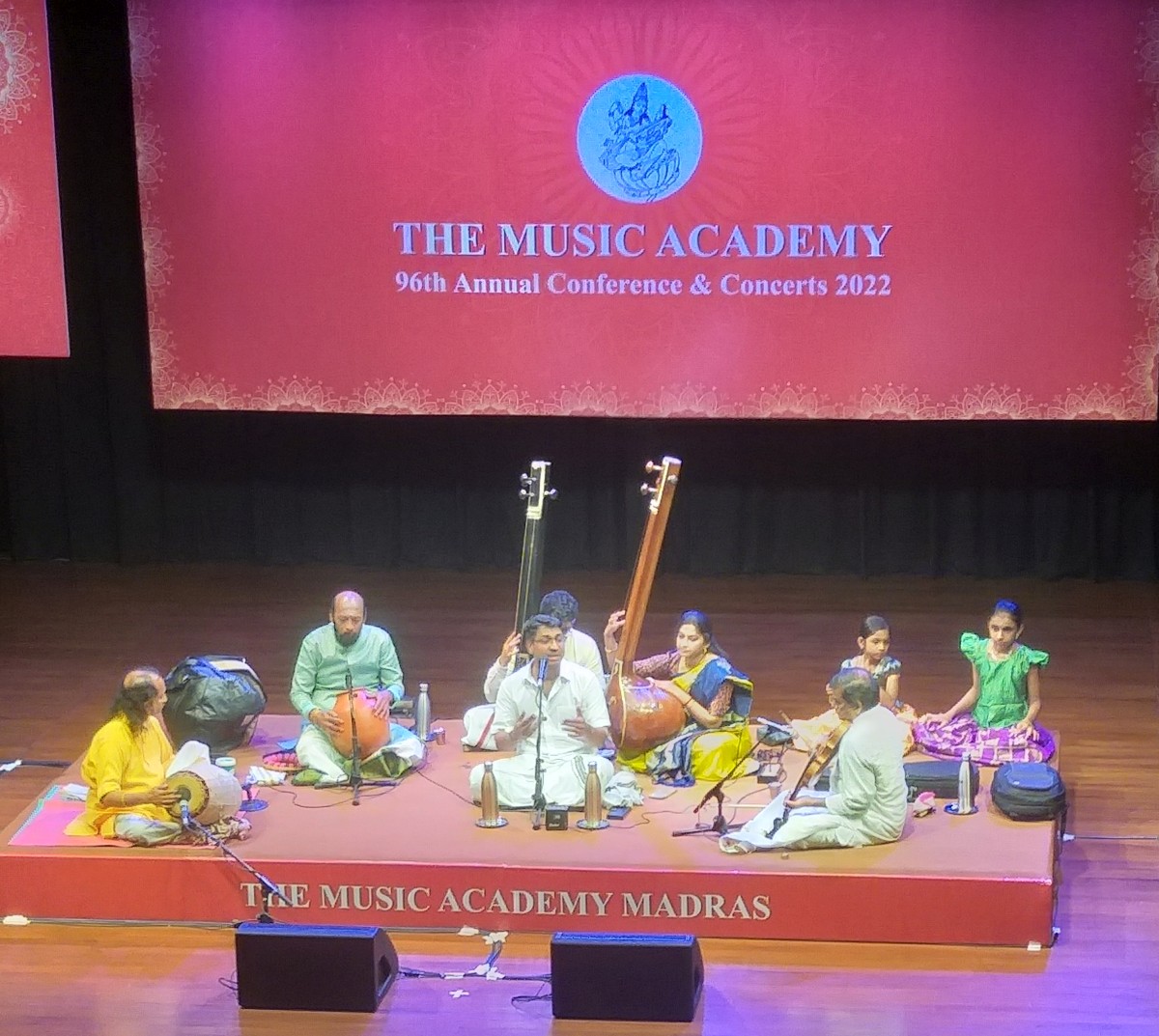
For this Tuesday concert, on 20th December, I started earlier to the venue. However, the people in the city decided to turn out in more numbers on the roads (and in the concert venue too, though not in line with my expectation for Vidwan Ramprasad and team). I was late and ended up meeting a friend in the canteen. It was supposed to happen before the concert, but met only as the first song had been completed. Valet parking could not help much, the delay of 10 to 15 minutes having happened by the time I entered the academy complex in the car. We nibbled on a "Sardar vadai" (whatever that may be - Punjabi or Gujarati or just a fancy name) and coffee, as we heard strains of a wonderful tODi and rAju veDala through the speaker setup in the canteen. After catching up on the history missed out in 3 years, in just a few minutes, we headed out to our seating areas. We kept in touch on WhatsApp - as good as being seated next to each other, as the conversations continued about the kritis, rAgams, rendition, etc - minus the sounds of talking sitting next to each other - as the team completed the tODi kriti.

Vidwan Ramprasad gave a very short glimpse of kannaDA before taking up the Muthuswami Dikshitar kriti shrI mAtrubhUtam. Then he took up a detail AlApanai of HindOLam. As I was wondering whether it will be sAmaja varagamanA, rAmanukku mannan, or other wonderful kritis in this rAgam, he took up mA ramaNan umA ramaNan. Though it was 2 out of 2 for me in 2 days, of the same song, the presentation details were different. While on the previous day it was a simple full rendition of the song between two main songs, on this day it was a very detail handling of HindOLam. The kalpana swarams also poured out showing his imagination as well as his expert knowledge of the laya aspects, which is not surprising considering his lineage from one of the stalwarts of laya.

After a brief AlApanai of pUrvikalyANi (my guess), he sang the rarely rendered kriti sharanara surabhOja, a composition of Kamaleshadasa. A search of the internet sites could not confirm the rAgam, nor was there info of the rAgam it is usually sung in. So, I will stick to assuming pUrvikalyANi, unless an expert corrects me.

mukhAri nI maHima

Vidwan Ramprasad then took a very detail exploration of mukhAri. It was bhava laden AlApanai with elaborate manOdharma coming to the fore. The relaxed and slow build-up and completion of AlApanai, were clear signals that it would be the most important rendition for the evening. Vidwan Gopinath on the violin played a good follow-up to the AlApanai as he had settled down into the groove by then. As the kriti Emani nE nI maHima unfolded we got a complete package of the Vidwan's control, vidwat, alignment to shruti, involved singing, appreciation of the laya vidwans' sensitive & superb accompaniment (J Vaidyanathan and S V Ramani), etc. The goddess of mukhAri was completely displayed in all detail in the AlApanai, kriti, neraval, and kalpana swarams. A wonderful laya vinyAsam rounded off the evening, as we were quite close to the close of the concert schedule. Vidwan Ramprasad then sang a rare Thyagaraja composition set to yamunA kalyANi, 'HaridAsulu veDale', before closing with the traditional mangaLam sung at a leisurely pace.

The rasikas are indeed fortunate to listen to such soothing music on both days. The fact that the bhairavi pallavi keeps running in the mind and the mukhAri elaboration pops into the head unannounced, are enough proof for me that the artistes were able to keep my undistracted attention on their music & soak my mind in that experience.

Special thanks to very good balance of the sound systems and settings, which many a times has been found wanting in many venues in the past, including Music Academy. In my opinion, it is nothing wrong in restating that the sensitive music was made more enjoyable by the acoustics and sound systems.

PS: This post is by a human, and not a bot, and the human is not bought either.

Disclaimer: If anyone thinks the above is artificial intelligence, it may be true about my music knowledge - but AI/ML not involved in the writing, facts, or opinions.

Monday, 30 December 2019

Serene concert of Vidwan Girijashankar

On Saturday, 28th December, 2019, we had the pleasure of attending a nice concert of Vidwan Girijashankar Sundaresan accompanied by Vidwan Pappu Gyandev on the violin and Vidwan Sudhindra on the mridangam. Chennai Fine Arts hosted this concert at Shastri Hall, Mylapore. All the artists were ready, including a complete sound check done, by 10 minutes before 3 PM! The artists as well as the audience were having an awkward wait, before Girijashankar requested the organizers at 5 minutes to 3 PM, whether they could begin the concert. The organizer was kind enough to permit saying "Though the regular audience would be walking in, expecting the start of concert at 3, let those who are already present have the pleasure of listening to one extra song."


Girijashankar Sundaresan, Pappu Gyandev and Sudhindra
With vigour, Girijashankar began with the Adi tALam kalyANi varnam, vanajAkshirO. This was rendered in a brisk pace, Pappu and Sudhindra playing softly and warming up to the concert. At this point I would like to point out that the audio was set optimally for the hall - not too loud, unlike some sabhas and organizations set things up, now-a-days! I also noticed that it was all controlled from a Pad device - looks like they have got the right audio folks, unlike some old sabhas still sticking to their old associations and technology! :-( OK enough of the deviation from the topic.

Girijashankar & Pappu gave a short AlApanai of Anandabhairavi before they sang the Shri Shyama Sastri kriti pAHishri girijAsutE set to rUpaka tALam. The next song was also a good surprise, which is not heard much of late in the first part of concerts - rAgam naLinakAnti. After a different structured AlApanai in this rAgam (to me it seemed more weightage was given to avarOHanam also, without losing the beautiful colour of naLinakAnti), Girijashankar took up Thanjavur Shri Sankara Iyer kriti, natajanapAlini naLinakAnti. It has been ages since I heard this and it was refreshing presentation.

The big elaboration for the afternoon was in mAyAmALavagowLa, which was again taken up from a different part of the scale. Both Girijashankar and Pappu gave an elaborate essay, followed by vidulaku mrokkEdA, the composition of Saint Thyagaraja. Neraval and Kalpanaswarams were rendered with ease by both, and Girijashankar used his nice voice well. Sudhindra then presented a very detail laya vinyAsam.

Girijashankar closed the concert with the husEni kriti of Arunachala Kavirayar, eppaDi manam tunindadO and the beHAg tillAnA of Lalgudi Shri G Jayaraman, in a flourish. Concerts of hour and 15 minutes are difficult to plan for - and we could understand the team's intent to take an extra 5 minutes, by starting early. Hope organizers give at minimum an hour and half for concerts. It was satisfying afternoon spent with the music & the good audio settings in Shastri Hall.

Monday, 23 December 2019

Musiri Chamber - Divine Nagaswaram Concert of Desur Selvarathinam and party

Usually I do not write the notes on concerts that are webcast live, especially, if it will be available online for a while for everyone to enjoy for themselves. No 3rd party commentary (mine) is required for the rasikas who view such concerts. However, in this case, I would like to bring the outstanding concert to the notice of the rasikas who may miss this one. Here are the simple concert notes, while the rest is available for you to enjoy direct from YouTube.
Kanchi Kamakshi Temple Vidwans Desur Selvarathinam along with his sons Shri Shanmugasundaram (dressed in red) and Shri Sethuraman (sitting on right hand side of Shri Selvarathinam, in white) performed on Sunday morning, 22 December 2019, from 10 AM, along with Vidwan Velliambakkam Palanivel (blue shirt) and Vidwan Pondichery Saravanan (olive green shirt).
Simply put this was a divine concert with amazing shruthi alignment of all 3 Nagaswaram vidwans, very well supported by the Thavil vidwans. In the words of a parama rasika of Carnatic Music, especially Shri Muthuswami Dikshitar kritis, the Musiri house was converted into a temple by their music. In conclusion - don't miss watching /listening to this - if you don't have time, do so in parts. Full stop.
Triple Nagaswaram - Desur Selvarathinam and Party
  1. siddhi vinAyakam sEvEHam - mOHanakalyANi - Adi - Harikesanallur Muthaiah Bhagavatar
  2. rItigowLai - janani ninnuvinA - misra cApu - Subbaraya Shastri
  3. Arabhi - sAdincenE O manasA - Adi - Thyagaraja
  4. lalitA - HiranmayIm lakshmIm sadA bhajAmi - rUpakam - Muthuswami Dikshitar
  5. shuddha sAvEri - dArini telusu konTi - Adi - Thyagaraja
  6. karunincuTaku idi samayamayyA - sindhumandAri - Adi - Patnam Subramania Iyer
  7. shanmukhapriyA - ekAmrEsha nAyakim - Adi - Muthuswami Dikshitar
  8. shrI cakrarAja simHAsanEshvari - rAgamAlikai (cencuruTTi, punnAgavarALi, nAdanAmakriyA, sindhubhairavi) - Adi - Agastiyar
  9. beHAg kriti jAvaLi
  10. kApi - pazhani ninRa - rUpakam - Periyasami Thooran
  11. eppaDi pADinarO - karnATaka dEvagAndhAri - Adi - Shuddhananda Bharathi
  12. bAgeshrI kriti
  13. tiruppugazh in HamsAnandi
  14. mangaLam
Repeating the conclusion - Don't miss. PS: When you go to Kanchi Kamakshi temple hope you get time to listen to them in the divine settings.
YouTube channel name - Musiri Chamber
URL for this concert - https://youtu.be/I3HR6rBrpz8

PS: Thanks to clarification by Shri Sethuraman, son of Shri Desur Selvarathinam, item number 9 is a jAvaLi - nirupama svAmi ninnu - beHAg - rUpakam - Poochi Srinivasa Iyengar. Also, item number 12 is jaya jAnaki ramana - bAgeshrI - kanDa cApu - Badhrachala Ramadasar.

MMS2019-03 - Melodious soulful music - Vidwan Saketharaman at MFAC

Vidwan Saketharaman gave us a thorough musical treat on 20 December, 2019, at Mylapore Fine Arts Club (TAG-MFAC Auditorium). He was accompanied by Vidwan Nagai Muralidharan on violin (from whom he is continuing his learning now), Vidwan Trichy Harikumar on Mridangam and Vidwan K V Gopalakrishnan on the kanjira. As this is the first concert I am attending in this season at TAG-MFAC, I was happy to note the pleasing backdrop colour choice. Also, in this concert the audio seemed to have been set well by the engineers and artists, and volume was also set to reasonable medium level, instead of usual blaring speakers. This added to the serene quality of the two and half hours of brilliant exposition by the stalwarts.
Saketharaman began the concert with the nATTa kriti 'rE rE mAnasa bhajarE' composed by Shri Cheyyur Chengalvaraya Sastri, set to rUpaka tALam. This set the mood for the entire evening. If that was not enough to indicate, he quickly moved on to Thiruppavai portion 'Azhi mazhai kaNNA' in varALi rAgam (we won't mind the rain, more rain and rain again anytime in Chennai - so bring it on please).
Saketharaman and Team - AlApanai in progress
The first elaboration for the evening was khamAs. Though some may consider this as a lightish rAgam, both Saketharaman and Muralidharan brought out the various possibilities of this rAgam, especially with guidance of Dikshitar kritis. The Shri Muthuswami Dikshitar kriti 'santAna gOpAlakrishNam upAsmaHE' was sung in leisurely manner. These choices and those to come were all contributing to the tone for this concert. Another detail presentation of AlApanai followed, in the rAgam yadukula kAmbhOji. When Saketharaman had completed a good essay, Muralidharan took off and showed a few extra facets in his compact rendition. The Shri Subbaraya Sastri kriti in misra cApu tALam, 'ninnu sEvinci' was sung & played with aplomb.
At this time I have to mention that Harikumar and KVG played quite softly all through the concert, especially for khamAs and yadukula kAmbhOji kritis, beautifully aligning with the choices of songs as well as the mood of the concert. The volume for the percussions were also a tad lower than for vocal and violin - this also helped. Maybe many sabhas and auditoriums can learn from this setting. It was really soothing for the ears and the artists made it soothing for the soul. Saketharaman announced that he had learnt this kriti from Muralidharan - no wonder both worked in tandem to present this superb composition. A medium paced 'rAkA sashivadanA' in rAgam takka was presented next, after which he announced the rAgam and sang the ArOHanam-avarOHanam. Possibly he saw a few quizzical looks, which augurs well too, in the sense that not many are searching the internet on their mobile, but trying to figure on their own.
Then came the main item for the evening in bhairavi. After the first phrase, he seemed to be motivated into a higher level, that the gloves were off... eh, I mean he took off his spectacles. Maybe he wanted everything to just flow freely. Manodharma unfettered! This was followed by sari evvarammA of Shri Shyama Sastri in kanDa jAti jhampa tALam. The neraval and kalpanaswarams were followed by a brilliant tani avartanam by Harikumar and KVG, where lot of nuanced korvais were played (though I don't understand much), as thoroughly appreciated and enjoyed by all the 4 artists! The two also ensured that after 2 exchanges, they did not go into regular kuraippu exchanges, but played the closing laya vinyAsam together, before Saketharaman continued with repeat of caranam 1, followed by the svara sAHityam in two speeds. A complete rendition of bhairavi and combined with laya vinyAsam - total satisfaction.
Of course, this is not enough for us, right? Clock said we had 50 minutes to go - giving lot of comfort that a rAgam-tAnam-pallavi is definitely in store for us. He presented a short sArangA composition 'kaNmaNiyE shollaDi' of Shri Mazhavai Chidambara Bharati, before the spectacles came off again (to stay off till end of concert). The ghana rAgam Arabhi was chosen for the rAgam-tAnam-pallavi, the entire AlApanai for which was presented in one stretch. The tAnam was presented in four parts - after the first part in Arabhi, Saketharaman chose kANaDa and shubhapantuvarALi for the next two parts, before returning to Arabhi to close it. The pallavi was set to tisra jAti jhampa tALam in kanDa nadai - ArabhimAnam vaittAdarippAr angayarkanni. They made it look so simple! After singing in different gaits, Saketharaman started the kalpana swarams in rItigowLa, sUryA, and bAgEshri, before the final set in Arabhi. With all these variations & detail presentation, he still managed to finish it leaving time for couple of tukkaDAs.
The rAgamAlikai 'kaNNanai kANbadeppO' in HamsAnandi, nATTakurinji, shuddha dhanyAsi and AbhOgi was followed by the paras tillAnA before the mangaLam. Melodious music, good setting of acoustics, free flowing manOdharma, all 4 stalwarts - everything contributed to a very happy evening! Look forward to listening to them for many more years to come.

Sunday, 22 December 2019

MMS2019-02 - Trivandrum Dr. G Baby Sreeram at Music Academy

We had the pleasure of enjoying a well planned concert of Dr. Baby at the Music Academy, on 19 December 2019. She was accompanied by Vidushi Padma Shankar on the violin, Vidwan Nellai A Balaji on the Mridangam and Malaikottai R M Deenadayalu on the Moharsing. The morning concert began on the dot at 9 AM, as we sat listening from the canteen - yeah, we were a bit late & had to listen to the first two compositions from there. The clarity was muffled by the pedestal fans and general chatter - so could not identify the kalyANi varnam (probably the aTa tALam varnam) and a popular shrIranjani kriti (the caranam was clearer but hands were busy stuffing the mouth; instead of noting the lyrics on pad / mobile).
We were comfortably seated in the back rows when Baby presented a serene version of the sowrAshTram based kriti 'shrI ranganAtuDE', of Thiru Ponnaiah Pillai. The first detail exposition for the concert was danyAsi, where Baby's delineation was dripping with bhAvAm and followed well by Padma. The kriti 'shOdippadenna nyAyamA' composed by Shri Neelakanta Sivan was sung in detail with neraval and kaplanaswarams to give justice to this choice. Then, after a brief AlApanai in kaNNaDA, Baby sang the rarely heard (at least for me) Saint Thyagaraja kriti 'sAkEta nikEtana'.
Dr Baby Sreeram and Team in progress
ShanmukhapriyA was taken up as the main rAgam for the morning, with a different start off point than I have heard so far. From this and other details displayed in pallavi of the day, it was clear that Baby had planned novelty while sticking to the patantaram and melody of music. After her detail essay, Padma presented a compact version of the rAgam too, followed by the kriti 'mAmava karuNayA', a Maharaja Swathi Tirunal composition set to misra cApu tALam. Neraval and kalpanaswarams were compact too, and then we realized that the laya vinyAsam was going to follow, though it was just about 10:30 AM (1:30 hours into the concert). Both Balaji and Deenadayalu gave a good detail vinyAsam in the misra cApu tALam, with some interesting starting and landing points, as they were not on the samam. In my opinion, it takes quite a bit of practice and vidwath to be able to do that. Looking at the time utilized judiciously by the team, we were sure the next item would be a rAgam-tAnam-pallavi (45 minutes to go in the time allotted).
Baby took up sAvEri rAgam for the pallavi, the rAgam covered in one single stretch. The tAnam was sung & played well by Baby & Padma respectively in alternate phases initially and ending in an complementary sequence. Baby announced that it is a simple pallavi and hence not going to explain - an Adi tALam pallavi in kanDa naDai, which went 'enakkoru varam nI aruL shabEshA, vEriDam Edum illai abhaya'. As the pUrvAngam ended with shabEshA, in one avartanam she highlighted the name of the rAgam by ending instead at "shabE'shA vEri'". After the tri-kAlam presentation she directly moved to rAgamAlikai presentation of the pallavi and kalpanaswarams in each of the following rAgams. The first choice was 'varamu' (shuddha HindOLam), which again she highlighted a bit in one cycle at 'enakkoru varamu'. The other rAgams in sequence were Anandabhairavi, varALi, kAmbhOji and HamsAnandi. Following this she presented the kalpanaswarams in sAveri and then all the rAgamAlikai swarams (one avartanam each) in reverse order. By the end of the rAgam-tAnam-pallavi rasikAs would have definitely understood the nuanced presentation that had been planned and executed. Kudos to Baby & Padma for including this comfortably in the two-and-half-hour concert.
After a short viruttam in HindOLam and rEvati, Baby sang 'ariyAdadEnO umadarumai' in rEvati (kanDa cApu tALam) - could not find the composer in my limited searches. Maybe a composition of her own (or her husband Palakkad Sreeram?). And it closed exactly on the dot, as the clock literally flipped to 11:30 AM.
A scan of the audience showed lot of artists, young-and-old, junior-and-top-grade, etc. From this and a few other indicators (the booklet of all concerts in Chennai showing at least 50+ per day), we are assured that some journalists (writing in prominent newspapers) are either in a cocoon, blind, in denial, or have an agenda of promoting some specific group(s), when they say that Carnatic music's flag is being held high only by the efforts of the specific group(s).

Saturday, 21 December 2019

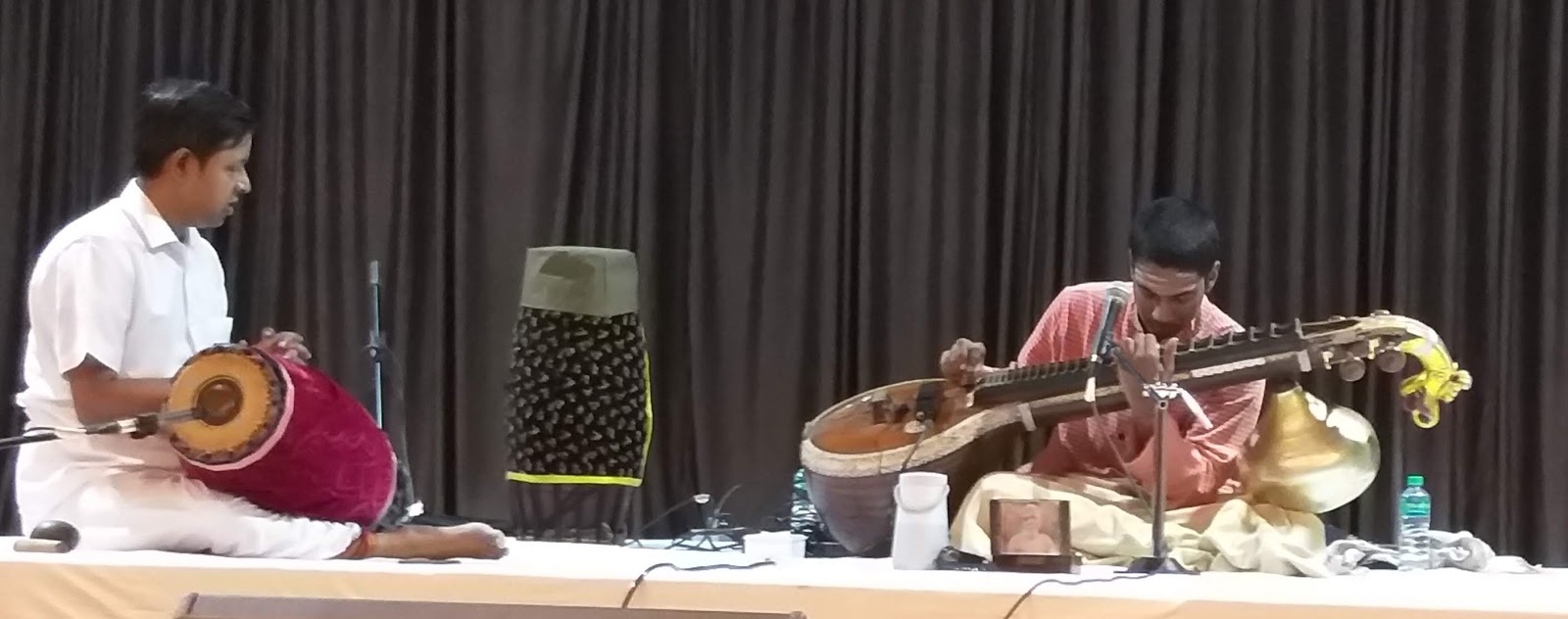
MMS2019-01 - Veenai Vidwan Ramana Balachandran at CMI

Veenai Vidwan Ramana Balachandran at CMI

On Wednesday, 18 December, 2019, at Chennai Mathematical Institute, Ramana performed a Veenai recital along with Vidwan Arvind Ranganathan on the Mridangam. This was a pleasant concert in the Auditorium with good acoustics. He began the evening's proceedings with Saint Thyagaraja kriti 'ninnE bhajana' in nATTa rAgam, after a brief AlApanai. This was followed by a good AlApanai in bhairavi before presenting Shri Muthuswami Dikshitar's panca bhUta stala kriti 'cintaya mA kanda mUlakandam', on the pritvi lingam in Kanchipuram.
AlApanai in full flow
After the detail bhairavi came aTu kArAdani in the rAgam manOranjani, another composition of Saint Thyagaraja. The fourth rAgam played was nATTakurinji, in brief, before the song 'vazhi maraittirukkudE' of Shri Gopalakrishna Bharathi was rendered. In each of the four compositions, Ramana sang the pallavi, anupallavi & caranam in brief, before playing all the sangatis, as seems to be his style of recital.
The detail presentation of the evening was kalyANi. Ramana was in his elements and explored this heavyweight rAgam in full detail, immersed in the rAgam and thoroughly enjoyed it, as did we. The Maharaja Swathi Tirunal kriti, 'pankaja lOcana' set to misra cApu tALam was the song chosen for the evening. After the song, the kalpanaswarams were played in alternate manner, whereby the mridangist played the korvai after each veenai exposition.
Next came a short interlude of the bindu mAlini kriti of Saint Thyagaraja, 'enta muddO', before he announced a short rAgam tAnam pallavi in brindAvani. He revelled in presenting the rAgam and tAnam in this rAgam, before singing a few Avartanams of the pallavi - 'gurunAtA aruNa gurunAtA ramaNA karuNA saccidAnanda' set to Eka tALam in misra naDai (if identification of tALam is wrong, mistake is mine). The pallavi was played in three kAlams as well as a few technical variations (as a layman, don't know much of that). This was followed by detail kalpanaswarams and the laya vinyAsam by Arvind. Arvind took his time to demonstrate the various gatis and kAlapramAnams over full 10 minutes & showed his prowess.
Ramana then closed the concert by playing a kriti in saHAnA before the traditional 'mangaLam' and 'aruNAcala shiva' bhajan.
There are many rasikAs who really appreciate Ramana's vocal rendition of portions of each song, before completing all the different sangatis on the veenai. The composition is then identified for the rasikAs and we can appreciate more. He has a very good voice and control too, to really do a great job in singing. However, in my opinion, the singing of anupallavi / caranam(s) are small check-dams in the smooth flow of the river. Somehow the mood of the kriti seems to get disturbed a bit by the switch to vocal 2 or 3 times for each composition. I would like to get more people's opinion on this aspect of the veenai recital.
Overall a nice conert in a superb auditorium with excellent acoustics, with bhairavi, kalyANi and brindAvani played very well and in detail.

Sunday, 3 November 2019

4 Concerts during Navaratri at Malleshwaram

As part of Jagadguru Jayendra Saraswati Swamigal's Avatara Mahotsav held in Shri Kanchi Kamakoti Shankara Matam, Malleshwaram, every year, 10 concerts were held during the Navatri period this year. Following up on the earlier posts covering other concerts, here are the notes of the remaining 4.

The concerts on 6th to 9th days of the Mahotsav featured excellent concerts of Smt Gayatri Venkatraghavan (Friday, 4th Oct), Vidwans Mysore brothers (Saturday, 5th Oct), Shri Abhishek Raghuram (Sunday, 6th Oct) and on Saraswati Poojai evening Shri Rajesh Vaidya (Monday, 7th Oct). Each of these concerts had a unique touch. While the artists in the first two of these concerts asked the audience to suggest the compositions to be rendered, right at the beginning of the concert, the next two concerts seemed like predominantly artist choice.

Smt Gayatri Venkatraghavan began the concert with shlokam in rAgams yamunA kalyANi and nATa, before taking up the nATa kriti pAHimAm shrI rAjarajEshvari set to tisra gati Adi tALam a composition of Shri Shyama Sastri. She then took up Shri Uthukkadu Venkatasubbayyar's navAvarna kriti in kalyANi, vAcasiyadi. A brief AlApanai of kamalAmanOHari by her and Shri C N Chandrasekar was followed by kancadalAyadAkshi composed by Shri Muthuswami Dikshitar. Another of his lilting compositions followed, amba nIlayatAkshi set to nIlAmbari rAgam.


tAyE tripura sunDari composed by Shri Periyasami Thooran, set to shuddha sAvEri rAgam was followed by an elaborate presentation of bhairavi. The main composition for the day was janani mAmava, which was followed by a compact laya vinyAsam by Delhi Sairam. His accompaniment throughout the evening was in step with the prayerful mood of the concert. Then there was a flurry of small kritis, per the requests from various rasikas in the audience. nAn oru viLayATTu bommaiyA in navarasakannaDa, kanakashaila viHAri in punnAgavarALi, a tirupugazh on Maha Periyava (vEdam nAnginai kaTRu kodutta) in cencuruTTi followed by tUmani mADattu in HamIr kalyANi were soulful renditions. The concert was closed by brisk rendition of tiruppugazh agaramum Agi in sindhubhairavi and karpagamE in madhyamAvati.

The following day, on the birthday of Shri Mysore Manjunath, the concert of the Mysore brothers Shri Nagaraj and Shri Manjunath was held at the matam. They were accompanied by Shri Thiruvarur Bhaktavatsalam on mridangam and Shri Sundar Kumar on the kanjira. In this concert, they presented the compositions in leisurely manner and gave elaborate treatment for each AlApanai and rendition. We thoroughly enjoyed the 4 pieces played on the day. The concert began with a very sedate Anandabhairavi AlApanai followed by marivErE, a composition of Shri Shyama Sastri. vAcaspati was the second rAgam played by the brothers, and the composition chosen was parAtparA paramEshvarA. The third song of the evening was Maharaja Swathi Tirunal kriti, sArasAksha, after detail delineation of pantuvarALi.


As per audience request, a rAgam tAnam pallavi in beHAg was played by the Mysore brothers, with the pallavi line being dEvi shrI tripura sundari kAmAkshi, set to Adi tAlam. Very traditional touches were played, as well as some Hindustani style sangatis. This was followed by rAgamAlika swarams in kAnaDA, sAvEri, Arabhi, which led on to a flourish of nAgaswaram-concert-like tandem rAgamAlika swarams for 1 avartanam or 1/2 avartanam in a myriad of rAgams. This type of tandem rAgamAlika swarams I have not heard from other instrumentalists, except the nAgaswaram. Rasikas may kindly comment on whether this type of playing rAgamAlika is a regular feature from the Mysore brothers, or others in instrumental concerts.

On 6th October, it was an overflowing hall for Shri Abhishek Raghuram's concert, accompanied by Shri Vittal Ramamurthy (violin), Shri Thiruvarur Bhaktavatsalam (mridangam) and Shri Alathur Rajaganesh (kanjira). The concert started with a sedate shankarAbharanam AlApanai followed by somber rendition of svara rAga sudhA. The second song rendered was sUryamUrtE on the Sunday evening, the navagraHa kriti in sowrAshTram composed by Shri Muthuswami Dikshitar. With a brief and crisp AlApanai in jayantasEna, Shri Abhishek took up vinatAsuta vAHana, a composition of Saint Thyagaraja.


Shri Abhishek then sang a brief kIravANi followed by the Appar tEvAram 'vAnanai mathi sUDiya' (Thiruvannamalai kshetram), starting off from the second half of the verse. The next song chosen was jAlandara supItastitE, in valaci rAgam, a composition of Shri Harikesanallur Muthaiah Bhagavatar, which was sung from the anupallavi after a brief AlApanai.

The first major elaboration of AlApanai was reserved for dEvagAndhAri. After both the artists had completed the AlApanai, Shri Abhishek took another minute to explore a few phrases in the upper octave as though he felt he had missed it in the initial AlApanai. He took up from the anupallavi of shAradE vINA vAdana, that is, at nArada jananI catur nAyaki, a composition of Shri Papanasam Sivan. This was followed by an excellent laya vinyAsam by Shri Bhaktavatsalam and Shri Rajaganesh, where the mridangist even goaded the other to complete some interesting korvais. At the ending korvai of one exchange Shri Rajaganesh's closure indicated a start of next pattern. Catching the pattern, Shri Bhaktavatsalam asked him to complete it, even if it seemed to extend beyond the usual exchanges.

Following this major item, Shri Abhishek sang two kritis of Shri Muthuswami Dikshitar. A soulful and slow presentation of rEnukAdEvi samrakshitOHam in kannaDa bangALa and bruHadIsvarO rakshatu mAm in gAnasAmavarALi (gAnamUrti). These seemed to indicate that we may have a second major song to follow. He sang a short AlApanai in Anandabhairavi, and then rendered nanganallUr ezhundaruL sarva mangaLE rAjarajEshvari, beginning with the caranam 'un perumaiyonDrum ariyEn', a composition of Shri Papanasam Sivan.

As time seemed to be running out, as it was already 9:10 PM or so (with most concerts ending between 9:10 and 9:30), the artist decided to take up an elaborate AlApanai of kalyANi. So, the lack of tukkadas seemed to rightly indicate that there was more to the concert. And what a kalyANi it was. Both Shri Abhishek and Shri Ramamurthy gave full justice to this majestic rAgam without any glance at the clock. Shri Pallavi Gopala Iyer's nIdu carana pankajamulE was the second elaborate composition of the evening. With the neraval and kalpana svarams, it was a full hour rendition of this piece. Shri Abhishek however indicated to the accompanists half-way through, that this would be the last item for the day. If Shri Rajaganesh did not have to rush to catch a bus / train, there may have been a second laya vinyAsam, as per Shri Abhishek's initial indications. The percussion artists closed the item with a very short kuraippu, following which the mangaLam was sung, well beyond 10 PM! A superb treat for all the rasikas, many of whom stood through a major portion of the concert!

Saraswati poojai evening was graced by a vINai concert, quite appropriate offering to the Goddess of Learning. Shri Rajesh Vaidya was accompanied by percussionists Shri Mohana Ram on mridangam, Shri Praveen Narayanan on the tabla and Shri Sai Hari on the ghatam. This concert was a typical fast paced offering from Shri Rajesh Vaidya, with many of the regular compositions suited for the instrument. He began with obeisance to all Periyavas with endarO maHAnubhAvulu, followed by brisk renditions of nIdaya rAdhA in vasantabhairavi and telisi rAma in pUrnacandrikA. Then came the first AlApanai of amrutavarshini followed by Shri Harikesanallur Muthaiah Bhagavatar's sudhAmayI sudhAnidE.


He then alternated the brisk manavyAlakim in naLinakAnti, a slow simHendra madhyamam kriti kAmAkshi kAmakOTi (of Shri Muthuswami Dikshitar), and a fast raghuvamsha sudhA in kadanakutUHalam. He next announced he would render a rAgam tAnam pallavi, and the rAgam chosen was pantuvarALi. A brilliant and elaborate rendition, with some gimmicks of playing long sangatis with single hand included, was followed by the pallavi on Mahaperiyava Jagadguru Chandrashekara Swamigal - 'aruL tarum jagadguru candrashEkarA anusham dinattil avadaritta' in Adi tALam. Elaborate kalpanaswarams and a boisterous laya vinyasam by the three percussionists rounded off this RTP. The laya vinyasam also included Shri Rajesh Vaidya's participation with some appropriate strumming at the end of korvais.

The concert rolled forward with several instrumental favorites, like ratipatipriya composition jagatjanani of Shri Ghanam Krishna Iyer, bArO krishnayyA of Shri Purandaradasa in rAgamAlika, bhO shambhO of Guru Dayanand Saraswati in rEvati, venkatAcala nilayam in sindhubhairavi and krishnA nI bEganE in yamunA kalyANi. Shri Rajesh Vaidya rounded off the concert with the wonderful maitrIm bhajata, poem of Mahaperiyava Jagadguru Chandrashekara Swamigal, continuing onto veda chanting phrases and concluding with candrashEkarA IshA in sindhubhairavi.

I have only two concerns about the two instrumental concerts. The addition of technology to provide different effects, with second output directly from the instrument, amplification, etc., were a bit intrusive in this smaller hall. Those may work out to be excellent presentations in bigger auditoriums which have good acoustics. However, these could have been appropriately adjusted for this simple hall of the matam. At times, the sound engineer could not perfectly adjust the artist-provided additional equipment to work along with regular equipment. Loudness, some interferences, etc., caused unnecessary interruptions, which can be avoided.