Sunday, 3 November 2019

4 Concerts during Navaratri at Malleshwaram

As part of Jagadguru Jayendra Saraswati Swamigal's Avatara Mahotsav held in Shri Kanchi Kamakoti Shankara Matam, Malleshwaram, every year, 10 concerts were held during the Navatri period this year. Following up on the earlier posts covering other concerts, here are the notes of the remaining 4.

The concerts on 6th to 9th days of the Mahotsav featured excellent concerts of Smt Gayatri Venkatraghavan (Friday, 4th Oct), Vidwans Mysore brothers (Saturday, 5th Oct), Shri Abhishek Raghuram (Sunday, 6th Oct) and on Saraswati Poojai evening Shri Rajesh Vaidya (Monday, 7th Oct). Each of these concerts had a unique touch. While the artists in the first two of these concerts asked the audience to suggest the compositions to be rendered, right at the beginning of the concert, the next two concerts seemed like predominantly artist choice.

Smt Gayatri Venkatraghavan began the concert with shlokam in rAgams yamunA kalyANi and nATa, before taking up the nATa kriti pAHimAm shrI rAjarajEshvari set to tisra gati Adi tALam a composition of Shri Shyama Sastri. She then took up Shri Uthukkadu Venkatasubbayyar's navAvarna kriti in kalyANi, vAcasiyadi. A brief AlApanai of kamalAmanOHari by her and Shri C N Chandrasekar was followed by kancadalAyadAkshi composed by Shri Muthuswami Dikshitar. Another of his lilting compositions followed, amba nIlayatAkshi set to nIlAmbari rAgam.


tAyE tripura sunDari composed by Shri Periyasami Thooran, set to shuddha sAvEri rAgam was followed by an elaborate presentation of bhairavi. The main composition for the day was janani mAmava, which was followed by a compact laya vinyAsam by Delhi Sairam. His accompaniment throughout the evening was in step with the prayerful mood of the concert. Then there was a flurry of small kritis, per the requests from various rasikas in the audience. nAn oru viLayATTu bommaiyA in navarasakannaDa, kanakashaila viHAri in punnAgavarALi, a tirupugazh on Maha Periyava (vEdam nAnginai kaTRu kodutta) in cencuruTTi followed by tUmani mADattu in HamIr kalyANi were soulful renditions. The concert was closed by brisk rendition of tiruppugazh agaramum Agi in sindhubhairavi and karpagamE in madhyamAvati.

The following day, on the birthday of Shri Mysore Manjunath, the concert of the Mysore brothers Shri Nagaraj and Shri Manjunath was held at the matam. They were accompanied by Shri Thiruvarur Bhaktavatsalam on mridangam and Shri Sundar Kumar on the kanjira. In this concert, they presented the compositions in leisurely manner and gave elaborate treatment for each AlApanai and rendition. We thoroughly enjoyed the 4 pieces played on the day. The concert began with a very sedate Anandabhairavi AlApanai followed by marivErE, a composition of Shri Shyama Sastri. vAcaspati was the second rAgam played by the brothers, and the composition chosen was parAtparA paramEshvarA. The third song of the evening was Maharaja Swathi Tirunal kriti, sArasAksha, after detail delineation of pantuvarALi.
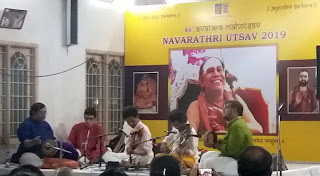

As per audience request, a rAgam tAnam pallavi in beHAg was played by the Mysore brothers, with the pallavi line being dEvi shrI tripura sundari kAmAkshi, set to Adi tAlam. Very traditional touches were played, as well as some Hindustani style sangatis. This was followed by rAgamAlika swarams in kAnaDA, sAvEri, Arabhi, which led on to a flourish of nAgaswaram-concert-like tandem rAgamAlika swarams for 1 avartanam or 1/2 avartanam in a myriad of rAgams. This type of tandem rAgamAlika swarams I have not heard from other instrumentalists, except the nAgaswaram. Rasikas may kindly comment on whether this type of playing rAgamAlika is a regular feature from the Mysore brothers, or others in instrumental concerts.

On 6th October, it was an overflowing hall for Shri Abhishek Raghuram's concert, accompanied by Shri Vittal Ramamurthy (violin), Shri Thiruvarur Bhaktavatsalam (mridangam) and Shri Alathur Rajaganesh (kanjira). The concert started with a sedate shankarAbharanam AlApanai followed by somber rendition of svara rAga sudhA. The second song rendered was sUryamUrtE on the Sunday evening, the navagraHa kriti in sowrAshTram composed by Shri Muthuswami Dikshitar. With a brief and crisp AlApanai in jayantasEna, Shri Abhishek took up vinatAsuta vAHana, a composition of Saint Thyagaraja.


Shri Abhishek then sang a brief kIravANi followed by the Appar tEvAram 'vAnanai mathi sUDiya' (Thiruvannamalai kshetram), starting off from the second half of the verse. The next song chosen was jAlandara supItastitE, in valaci rAgam, a composition of Shri Harikesanallur Muthaiah Bhagavatar, which was sung from the anupallavi after a brief AlApanai.

The first major elaboration of AlApanai was reserved for dEvagAndhAri. After both the artists had completed the AlApanai, Shri Abhishek took another minute to explore a few phrases in the upper octave as though he felt he had missed it in the initial AlApanai. He took up from the anupallavi of shAradE vINA vAdana, that is, at nArada jananI catur nAyaki, a composition of Shri Papanasam Sivan. This was followed by an excellent laya vinyAsam by Shri Bhaktavatsalam and Shri Rajaganesh, where the mridangist even goaded the other to complete some interesting korvais. At the ending korvai of one exchange Shri Rajaganesh's closure indicated a start of next pattern. Catching the pattern, Shri Bhaktavatsalam asked him to complete it, even if it seemed to extend beyond the usual exchanges.

Following this major item, Shri Abhishek sang two kritis of Shri Muthuswami Dikshitar. A soulful and slow presentation of rEnukAdEvi samrakshitOHam in kannaDa bangALa and bruHadIsvarO rakshatu mAm in gAnasAmavarALi (gAnamUrti). These seemed to indicate that we may have a second major song to follow. He sang a short AlApanai in Anandabhairavi, and then rendered nanganallUr ezhundaruL sarva mangaLE rAjarajEshvari, beginning with the caranam 'un perumaiyonDrum ariyEn', a composition of Shri Papanasam Sivan.

As time seemed to be running out, as it was already 9:10 PM or so (with most concerts ending between 9:10 and 9:30), the artist decided to take up an elaborate AlApanai of kalyANi. So, the lack of tukkadas seemed to rightly indicate that there was more to the concert. And what a kalyANi it was. Both Shri Abhishek and Shri Ramamurthy gave full justice to this majestic rAgam without any glance at the clock. Shri Pallavi Gopala Iyer's nIdu carana pankajamulE was the second elaborate composition of the evening. With the neraval and kalpana svarams, it was a full hour rendition of this piece. Shri Abhishek however indicated to the accompanists half-way through, that this would be the last item for the day. If Shri Rajaganesh did not have to rush to catch a bus / train, there may have been a second laya vinyAsam, as per Shri Abhishek's initial indications. The percussion artists closed the item with a very short kuraippu, following which the mangaLam was sung, well beyond 10 PM! A superb treat for all the rasikas, many of whom stood through a major portion of the concert!

Saraswati poojai evening was graced by a vINai concert, quite appropriate offering to the Goddess of Learning. Shri Rajesh Vaidya was accompanied by percussionists Shri Mohana Ram on mridangam, Shri Praveen Narayanan on the tabla and Shri Sai Hari on the ghatam. This concert was a typical fast paced offering from Shri Rajesh Vaidya, with many of the regular compositions suited for the instrument. He began with obeisance to all Periyavas with endarO maHAnubhAvulu, followed by brisk renditions of nIdaya rAdhA in vasantabhairavi and telisi rAma in pUrnacandrikA. Then came the first AlApanai of amrutavarshini followed by Shri Harikesanallur Muthaiah Bhagavatar's sudhAmayI sudhAnidE.


He then alternated the brisk manavyAlakim in naLinakAnti, a slow simHendra madhyamam kriti kAmAkshi kAmakOTi (of Shri Muthuswami Dikshitar), and a fast raghuvamsha sudhA in kadanakutUHalam. He next announced he would render a rAgam tAnam pallavi, and the rAgam chosen was pantuvarALi. A brilliant and elaborate rendition, with some gimmicks of playing long sangatis with single hand included, was followed by the pallavi on Mahaperiyava Jagadguru Chandrashekara Swamigal - 'aruL tarum jagadguru candrashEkarA anusham dinattil avadaritta' in Adi tALam. Elaborate kalpanaswarams and a boisterous laya vinyasam by the three percussionists rounded off this RTP. The laya vinyasam also included Shri Rajesh Vaidya's participation with some appropriate strumming at the end of korvais.

The concert rolled forward with several instrumental favorites, like ratipatipriya composition jagatjanani of Shri Ghanam Krishna Iyer, bArO krishnayyA of Shri Purandaradasa in rAgamAlika, bhO shambhO of Guru Dayanand Saraswati in rEvati, venkatAcala nilayam in sindhubhairavi and krishnA nI bEganE in yamunA kalyANi. Shri Rajesh Vaidya rounded off the concert with the wonderful maitrIm bhajata, poem of Mahaperiyava Jagadguru Chandrashekara Swamigal, continuing onto veda chanting phrases and concluding with candrashEkarA IshA in sindhubhairavi.

I have only two concerns about the two instrumental concerts. The addition of technology to provide different effects, with second output directly from the instrument, amplification, etc., were a bit intrusive in this smaller hall. Those may work out to be excellent presentations in bigger auditoriums which have good acoustics. However, these could have been appropriately adjusted for this simple hall of the matam. At times, the sound engineer could not perfectly adjust the artist-provided additional equipment to work along with regular equipment. Loudness, some interferences, etc., caused unnecessary interruptions, which can be avoided.

Wednesday, 23 October 2019

gItam 'varavINA mrdu pANi' as first elaboration of concert

On 8th October, 2019, Vidwan Sikkil Gurucharan concluded the 85th Avatara Mahotsava, of Jagadguru Jayendra Saraswati, at Shri Kanchi Kamakoti Shankara Matam in Malleshwaran with an excellent concert. He was accompanied by Vidwan C N Chandrasekhar on the violin and Vidwan Sumesh Narayanan on the Mridangam.
Vidwan Gurucharan wished everyone on the occasion of Vijayadashami and mentioned that since he was singing last in the series, most ragams and songs may have been explored already. He was in a difficult position and would do the best possible. He definitely excelled in that effort and we were treated to a very melodious concert with many intricacies included too.
He began the concert with a very short AlApanai as introduction to nirOshTA rAgam before he announced that he will take up Shri Tanjavur S Kalyanaraman's varnam in the rAgam that begins with 'kannin maNiyE'. The beauty of this rAgam and the various cittaswarams rendered added to the good beginning of the concert. He then took up the durgA pancaratnam, composed by Jagadguru Shri Chandrasekhara Saraswati, which is well known from Srimathi M S Subbulakshmi's renditions. This is set to karnAtaka shuddha sAvEri rAgam (S R1 M1 P D1 S, a janya of kanakAngi the first mELakartA), and sung in kaNDa cApu tALam.
For the first elaboration of the evening (I am not a fan of terms like sub-main), Vidwan Gurucharan took up mOHanam. The AlApanai was quite thorough and Shri Chandrasekhar also played a good follow-up in this rAgam. Then came the surprise of detail rendition of the mOHanam gItam, varavINA mrdu pANi. He rendered in a kriti style, with extended sangatis of each line and all the gamakams allowed in mOHanam. If one did not know that this is a gItam, they would have mistaken it for a kriti. He included neraval at the starting line itself and followed by kalpanaswarams.
After the rendition he mentioned that his gurus have always asked him and fellow students to sing gItams on Vijayadashami day as part of their start to the next year of learning. He also encouraged the many young children in the hall to keep practicing the basics regularly. Finally, he also mentioned that this was the first time he was rendering the nirOshTA varnam and the mOHanam gItam in a concert.
Next he sang parvatarAja kumAri in shrIranjani composed by Shri Muthuswami Dikshitar. This medium tempo song led us to the second exploration of the evening. nAsikAbhUshani was the chosen rAgam for presentation and Vidwan Gurucharan sang beautifully. Vidwan Chandrasekhar also followed-up with his AlApanai in this rAgam nicely. The extended step by step rendition made us think it would be the main piece for the evening. mAravairi ramaNi, a composition of Saint Thyagaraja, was taken up and they did full justice to the song. Vidwan Sumesh Narayanan provided very soft and appropriate support along with the mood set by the two artists.
The main rAgam for the day was tODi which, he had been informed by the organizer in the matam, was not presented in elaborate form by anyone earlier in the 9 concerts of the festival. It was a melodious and brilliant AlApanai by both the artists. Included in the AlApanai by Vidwan Gurucharan was a rendition of akArams without the shadjam and pancamam, leading to the mOHanam scale, with the tonic note set to ri of tODi, for a couple of minutes, before dramatically introducing the shadjam again to bring us back to the world of tODi. They presented ninnE namminAnu sadA of Shri Shyama Sastri, set to misra cApu tALam. The neraval at kAmAkshi kancadaLAya tAkshi was beautiful followed by kalpanaswarams and the thorough laya vinyAsam of Vidwan Sumesh. Rain was pouring heavily by this time, as though the goddess was very pleased with their music.
In contrast to many concerts, where experiments lead to phases of loudness overtaking the musicality, this was one of the few concerts where melody and softness of music were the only focus. The sound engineer had also set the speaker settings at a nice medium level (I hear many artists are to blame for requesting loud settings in many places; and in some cases each artist in the team asking for their mic output to be increased, like a competition).
Vidwan Gurucharan concluded the concert with two songs - first a rAgamAlika composed by Shri N S Chidambaram, in which the names of the rAgams appear, and the shrI rAgam kamalAmba navAvarnam, shrI kamalAmbikE with the mangaLam. The rAgams in the rAgamAlika are jaganmOHini, Anandabhairavi, sunAdavinOdini, kIravANi, kalyANi, nAyaki, ranjani and dEvagAndhAri.
Now, what happened to the other 9 concerts? Well, I had earlier posted brief notes about 3 of the first 4 concerts. I will followup this post with notes on the 4 other concerts of 4th-7th October, in the coming days.

Laya Vinyasam treat - Guru Karaikudi Mani and Vidwan Giridhar Udupa

On 3rd October, Guruvaaram, at Shri Kanchi Kamakoti Shankara Matam, we were given a special treat of laya vinyAsam by Guru Karaikudi Mani on Mridangam and Vidwan Giridhar Udupa on the Ghatam. I haven't heard a better laya vinyAsam live, where both the artists not only played intricate patterns, but also were completely in synchronization on all the long korvais that they played together. Whether it was superb anticipation of Vidwan Udupa to the Guru's playing or whether it is his knowledge and vidwat over period of time to know what the Guru would play, only the artists or experts can enlighten us. In most concerts, we have the followers trying to anticipate / guess the main laya vidwan, which leads to either gaps during unsure steps, or alternate korvai being played in parallel. Here, it was not the case at all. In each round of exchange, both the vidwans joined in last few avartanams and played the exact korvai in total syncronization. The final joint exposition by both ,over many minutes, was perfect & complete as a team! No difference in korvais. Amazing. I wonder if anyone would have a recording, so others can enjoy this treat too!
Coming back to the complete series of concerts, this laya vinyAsam was included in the Carnatic vocal concert of Vidwan Kunnakudi M Balamuralikrishna, accompanied by Vidwan H N Bhaskar on the Violin. This was a very good concert, as can be expected from such stalwarts. Earlier, Guru Karaikudi Mani was honoured by the Matam on occasion of Anusha nakshatram and guruvaaram, beginning his 75th year. Coincidentally, this matam in Malleshwaram was begun in the 75th year of Jagadguru Jayendra Saraswati Swamigal, now celebrating his avatara's 85th year in this mahotsav.
After felicitation of Guru Karaikudi Mani, he recounted some memorable interactions with Maha Periyava... Including how HIS touch of his injured hand, with multiple plates and screws, became better quickly and within a month he started playing again... and he is still playing with all the plates and screws in his hand.
Vidwan K M BMK made a nice choice of compositions, each from a different composer. Beginning with viribOni in bhairavi, he chose gowLa kriti on maHagaNapati by Shri Muthuswami Dikshitar. A brief AlApanai in asAveri followed by shrI kAnci nAyikE by Annaswami Shastri was the third item for the day. A viruttam-like rendition of a Purandara Dasa lyric in Purvikalyani was followed by another kriti of same composer mAnava janma doDDadu.
A brisk sarasa sAma dhAna in kApi narAyani was followed by the main for the day in madhyamAvati. Being navarathri mahotsav, pAlimcu kAmAkshi of Shyama Sastri was the main. As mentioned before, the laya vinyAsam that followed was a treat I have never felt in ANY concert - ever. The last two items were a kriti in HamIr kalyANi of Kamalesha vittala folowed by the brindAvani tillAnA of Dr. M Balamuralikrishna. A complete veritable feast from the stalwarts.
On the previous day, the 2nd October, Wednesday, another good concert was held, rendered by Vidushi Sangeetha Sivakumar accompanied by Vidwan RK Shriram Kumar on violin, Vidwan Sivaraman on Mridangam and Vidwan Guruprasanna on kanjira. Beginning with vidulaku mrokkeda, a Saint Thyagaraja kriti in mAyAmALavagowLa, she gave a brief AlApanai in jayantasEna followed by vinatasuta vAHana. The third song was prefaced by a good AlApanai from both, in bEgaDA, shankari nIvE being the appropriate kriti for the day.
Then a brief dEvi brova samayamidE in cintAmani was followed by very detail presentation of pUrvi kalyANi. mInAkshi mEmudam dEHi was sung in detail with usual neraval and kalpanaswarams, followed by the laya vinyAsam. The last three items for the day were pUnkuyil kUvum of Kalki Krishnamurthi in kApi, innudaya bAradE in kalyAnavasantam (prefaced by viruttam in HindOlam, saHAnA and kalyAnavasantam) and an abhang, dhAva vibhO karunAkara mAdhava, in yamunAkalyANi. The audience were suddenly left in lurch as she indicated the concert had ended.
Everyone was confused and people dispersed without any claps, leave alone an ovation. That was a bit odd, especially as the good concert seemed to end unappreciated. She has a booming voice and resonated in the hall. Hope the modified structure of such concert is explained to the audience for everyone's better understanding.
The 2nd concert of the series held earlier on 30th September, was by Vidushis Akkarai sisters Subhalakshmi and Swarnalatha. This concert had a very meditative tone, both in terms of choice of kritis as well as the renditions. It seemed very appropriate for a presentation at the matam's hall with Ambal's sannidi. They began the concert with tODi svarajati of Shyama Sastri, rAvE Himagiri kumAri. That set the pace and the mood for the entire concert. sItammA mAyamma in vasantA was the next song presented, followed by a very detail AlApanai of naganandini. Vidushi H M Smitha also presented a crisp version of the AlApanai. This AlApanai was followed by a composition of Akkarai Swarnalatha in naganandini, the lyrics of which I am not sure of - so I am not mentioning here. Vidwans Jayachandra Rao (mridangam) and Lakshminarayanan (mohrsing) played very well within the same mood of the concert with apt accompaniment.
The sisters surprised us by singing HiranmayIm in lalitA (as they had sung vasantA as second item). The main rAgam chosen was kalyANi, the AlApanai of which was followed by a viruttam (vandE mAtaram ambikAm) before taking up kamalAmbAm bhajarE. Another new composition we heard was one of their grandfather (Suchindram Shri S P Sivasubramaniam bhagavatar) kalai amudam, in rAgam nIlamani. Then came pAlaya vEnkata ramanA in a north Indian rAgam, probably related to shubhapantuvarALi. This was set by Hyderabad sisters, they announced. They completed the concert by singing karpagamE in madhyamAvati followed by mangaLam.

Monday, 18 February 2019

Excellent concert of Vidwan Sunil Gargyan

Anna Nagar Music Circle Trust hosted Vidwan Sunil Gargyan for the February concert, accompanied by veteran violinist Vidwan V V Ravi, Vidwan Trivandrum V Balaji on Mridangam and Vidwan V Sivaramakrishnan on the kanjira. It was heartening to see the hall was nearly full on Sunday evening (17 February).

Vidwan Sunil began the concert with the navarAgamAlikA varnam 'valaci vaci'. The second item was in rAgam ShanmuKapriyA, which he outlined briefly in a short AlApanai, before rendition of 'siddhi vinAyakam' of Shri Muthuswami Dikshitar, in rUpaka tALam, at a fast pace. It was in a very fast clip, wherein he and Vidwan Ravi presented well, though a slower rendition can allow to bring out more beauty in this composition and the rAgam. The kalpana swarams rendered by both of them were breathtaking, as it was in the same high speed.

Picture courtesy : Secretary Srikanth Krishnamurthy
Vidwan Sunil chose to give a good AlApanai of saHAnA to start the third song for the day. Both he and Vidwan Ravi brought out the melodious rAgam very well before the rendition of Shri Gopalakrishna Bharathi's lyrics 'tillai ambalatAnai'. After the song, Vidwan Sunil announced that the composition was set to saHAnA by Vidwan Sanjay Subrahmanyan.

The fourth rAgam began with a brilliant AlApanai of pUrna shadjam. The elaborate AlApanai by him and Shri Ravi were excellent and brought out the full facet of this rAgam. Even though there are some swara sancArAs similar to allied rAgams, there was no doubt left that he was singing pUrna shadjam only by using its own unique phrases. 'lAvanya rAmA', a composition of Shri Thyagaraja set to rUpaka tALam, was the kriti that was sung. Following it, a brisk rendition of a rare malayamArutam kriti danuDevvuDO dAsharatE was presented followed by a vilambita kAlam 'cEtah shri bAlakrishnam' in dwijAvanti of Shri Muthuswami Dikshitar.

The rAgam varALi was chosen for exploration. Vidwan Sunil presented it well and Vidwan Ravi followed it with a compact AlApanai showing his prowess on the violin. The song that was sung, 'mAmava mInAkshi' is a composition of Shri Muthuswami Dikshitar set to mishra Eka tALam. A brisk 'idi nyAyamA shrI rAmacandrA' in rAgam mALavi, composed by Shri Patnam Subramanya Iyer was the interlude before the grand main item for the day.

A very elaborate presentation of kApi AlApanai was a treat for all of us. The ease with which he covered the tri-stAyis and full throated singing without holding back was thoroughly enjoyed by us. Vidwan Ravi followed up with a shorter and crisp kApi. We hoped it would be 'inta sowkhya maninE' and it was indeed this composition of Shri Thyagaraja. The last time I heard it as a main song of the concert was in the 90s! Loved this treat which rounded off a nice choice of kritis. Excellent neraval at 'swara rAga laya' was sung, followed by kalpana swarams too. The tani avartanam that followed was very elaborate and nuanced too. Vidwan Balaji showed so many variations on the mridangam, while Vidwan Sivaramakrishnan chose to present some lightning strokes, which for me were unbelievable. To be able to roll them out with one hand, while other percussion instruments have two hands to bring out the similar sol was breathtaking.

The tukkaDa section of the concert included vandu kEtpAr illayO, a rAgamAlikA set to HindOLam, aTAnA and bilaHari, a composition of Shri Oothukkadu Venkatasubbaiyar (I believe; Vidwan Sunil announced as Smt. Ambujam Krishna; experts can help here) and khaMAs rAga viruttam followed by karpUram nArumO in kanda cApu tALam.

This was one of the satisfying concerts and evening well spent for us. We could see that Vidwan Sunil has a bright future ahead.

Saturday, 5 January 2019

December Music Season 2018 - Tidbits - Part 2

(Few hits, but a lot more misses in this part) 
Vidushi Gayatri Girish
The season brings not only music, but our enjoyment of others’ behaviour in social encounters as well. Or suffer a sting, if we falter in sticking to the high expectations of the rasika fraternity these events.
Let me start with a heartening thing that we noticed. 6 or 8 or 10 year olds sitting on the dais, taking notes and more importantly keeping the tALam impeccably throughout the concert indicates that we can be assured a continued lineage of interest in Carnatic Music. The music will be handed down and carried forward with interest generation after generation, I am sure. See below picture from Shri Abhishek Raghuram's concert at Narada Gana Sabha. Someone had posted on FB, of a boy playing a phantom Mridangam, in the Music Academy, while seated behind the Mridangist.
Vidwan Sruthi Sagar Flute, Vidwan Abhishek Raghuram Vocal and Vidwam Anantha R Krishnan mridangam
The joyful season it is in Chennai. It is the time to dress up in choice attire, just like we do for an important function in the immediate family. Deck ourselves in neatly creased dresses, jewellery to match, other accoutrements that synchronize, etc. Having said this, I unfortunately did not notice anything significant to report. Somehow eyes and the brain of the beholder did not behold properly.
One of things I loved is that many artists attended others' concerts. Wait. Or was it always the norm - and only now I am able to identify a few artists in the crowd? Having attended very few concerts in first 15 years of this century, maybe I cannot come to conclusion - I would like to know the inputs from our fellow rasikas on this aspect.
Why not some change to attend some dramas, we thought. Dramas and dances are also on the cards for December season. We enjoyed a sparsely attended 3ji of Shri Y G Mahendran, and decently attended Crazy Premier League of Shri Crazy Mohan. The former probably does not see patronage due to a political stance being taken in this political-comedy. As the actor himself announces, comedy in politics and politics in comedy. The ideas as well as the comedy are good and we enjoyed (3ji). CPL was obviously a block-buster. However it makes us think about patronage to dramas. Isn't it cheaper to watch comedy dramas and even historic / fiction based dramas, rather than watch Television serials for free. Through TV people learn all the bad things about relationships, or get into depression with negativity, finally ending up paying hefty charges to A or C Hospital, don't they?
Official photographers and those with special permissions move around the concert hall, auditorium or sabhas to catch some outstanding freezes in time of the performers. It is only a minor irritant if they decide to do so conspicuously instead of by stealth. But here was an official photographer who decided to use the flash in all his clicks at the concert. In my opinion, it is a major disturbance to not only the rasikas, but also all the performers. I wonder whether he got a good set of choice words in his ear. I cannot know the results, if such an event occurred, as I did not go to that sabha again this season. I hope the artists can give their views as well. A regular reader of this series should be able to see a click of the photographer in one of the previous posts!
Vidwan Yazhpanam Balamurugan
Chamber concerts are definitely in a different league in terms of ambience. During the music season, there is added advantage of a slightly sparser crowd. We can have a seat with lot more freedom, relaxation (less cramped postures), and adds to intimacy with the music & the performance. Here is a click from a mesmerising smile of the co-performer (nagaswaram) of Yazhpanam Shri Balamurugan at Musiri Chamber, that I felt like including here. He played very well along with the maestro to lift the concert on that day (and earlier day at Sivagami Pethachi Auditorium).
Reading newspapers in some obscure corners of the auditorium is likely okay. The earlier report mentioned one person being admonished as he was reading it noisily in the second row of Bharatiya Vidya Bhavan. That was outclassed by this person in the first row of the Music Academy. He was reading a tabloid type newspaper - maybe a Mylapore Times or a T Nagar Talk. I wonder how it affects the musicians. Just because it is a free concert, can we do this in the front row, at the "Kailash" of Carnatic music?
Random question, triggered by the snow white top of Kailash. Shouldn't the rasikas of Shri Sanjay Subrahmanyan dress up in white on 1st January?
Vani Mahal concert of Vidwan Sanjay Subrahmanyan
With respect to canteens, which is the main topic for many, I did not sample much, nor have the expertise to provide reviews on that aspect. I may not notice even if someone missed adding salt to the sambhar at times. Snacks at Sivagami Pethachi auditorium and Mylapore Fine Arts club were the ones sampled. For the first time in my life added a lunch at a sabha canteen - this one at the Music Academy - enjoyed the banana leaf lunch of Pattappas! I plan to hold on to the promises by dear friends for the filter kapi - but likely will happen only in December 2019 - see you then.

Tuesday, 1 January 2019

Two concert notes for the seventh report

This is the seventh note, and probably the last, for the 2018 music season. I will cover two concerts in this report.
On Thursday, 27th December, we were excited to attend the concert of Shri Abhishek Raghuram, accompanied by Shri J B Sruthi Sagar on the flute and Shri Anantha R Krishnan on the mridangam, at Narada Gana Sabha. The next day we attended the concert of Vidushi Aishwarya Shankar with added intention of sampling the "leaf lunch" of Pattappas, at the Music Academy.
Vidwans Sruthi Sagar, Abhishek Raghuram, and Anantha R Krishnan (L to R)
Shri Abhishek started the evening with a sedate AlApanai of Hamsadhvani. The flute accompaniment suits as much as a violin accompaniment would, in my opinion, and Shri Sruthi Sagar played a nice follow-up. 'vandEHam jagat vallabham' was the kriti chosen, which was followed by kalpanaswarams. He then chose saHAnA as the next rAgam for elaboration. With the relaxed items one after the other, we were wondering whether he was cautious after his throat infection 2 weeks earlier in the Kerala temple, where he cut short his concert after the first varnam.
Shri Abhishek sang Ee vasudhA following his AlApanai and it was rendered full of bhava. Moving phrases, lilting sangatis and can one doubt the scope of saHAnA in those aspects! The team thoroughly enjoyed the presentation, oblivious of the audience - competing with each other for small twists in korvais and sangatis which surprise one-another bringing out individual excellence! The appreciation of one another by the beaming smiles, raised eye-brows, etc., are really worth watching - we are not only audience but spectators in this concert.
And then the plane took off with pantuvarALi as the third piece for the evening. With this we were treated to Shri Abhishek in his regular full flow. A very long elaborate AlApanai he sang, which included to slow unfurling and the fast brigas at the end as well. Shri Sruthi Sagar then played a beautiful follow-up including show of his fingering skills at the conclusion. 'rAmanAtham bhajEHam' was the composition for this main item of the evening, kAshiramakriya rAgam as per composer Muthuswami Dikshitar's nomenclature. kAmavardhani / pantuvarALi are the names given to this rAgam - or they have all become synonymous now, if there was nuanced differences earlier.
This was followed by extended neraval and innovative kalpanaswarams. The sets of kalpanaswarams ended with different portions of the composition. Both the neraval and kalpanaswarams brought out the camaraderie of the 3 artists, each goading the other to higher levels of manodharma. This was followed by usual brilliance of Shri Anantha in his tani avartanam. With just this 3rd piece we found about 2 hours of the concert were over. The main had taken up about 1:20 hours or one and a half hours, and we did not notice - drenched in the excellent music.
A brief AlApanai in bhairavi was followed by a superb 'ela rADAyane kAmini', rendered at a brisk pace. The melody is still ringing in my ear. We were hoping the next one would be a rAgam tAnam pallavi, but a gentleman came and requested Shri Abhishek giving two options. We could only hear that "I will sing candracUDa itself". He launched into a soulful darbArikAnaDA followed by a melodious candracUDa. Though we have heard him sing this before, everytime he manages to move us by the rendition. And then suddenly the mangaLam was sung. Oh my - only 2:15 minutes? This was a bit disappointing - maybe the 7 PM slot is for 2 hours or extended by 2:15 only, at Narada Gana Sabha - we don't know. We obviously want more - and this team deserves more time to present a full concert.
The hall was nearly full, but it was a bit disappointing to note that the first two rows was just half-full. This, I think, is because a single ticket is issued for both the 4 PM and 7 PM concerts. There are a few rasikas who like only the one or the other, and hence the some seats stay empty.
Another interesting aspect is that relatives of Shri Lalgudi G Jayaraman had monopolised the evening at Narada Gana Sabha. 4 PM concert was by Shri Ganesh and Shri Kumaresh. 6:45 PM concert in the NGS mini-hall was a Shri G J R Krishnan for Charsur, in the Samskritam series. Isn't it also a dilemma for the family members to choose between these concerts? At least Smt Jayanthi Kumaresh avoided the dilemma by playing a concert in distant Guwahati the same evening, and not be tugged by conflict of schedule at NGS.
Vidwan B S Prashanth, Vidushi Aishwarya Shankar, Vidwan G Badrinath (L to R)
The next day, we decided to attend the 11:45 AM concert of Vidushi Aishwarya Shankar at the Music Academy. Chidambaram Shri G Badrinath played the violin and Shri B S Prashanth played the mridangam. After singing a short shlokam in kalyANi, Vidushi Aishwarya began the concert with the kEdAragowLa varnam, sAmi dhaya jUDa. A very relaxed shrI varalakshmI in shrI rAgam was the second song. Vidushi Aishwarya chose latAngi rAgam for the first major item of the afternoon. A very nice AlApanai was followed by Shri Badrinath's crisp essay of the same. marivere dikkevvaru was rendered including kalpanaswarams.
Then, after a quick indication of dEvagAndhAri, she took up nA moralagimpavE of Saint Thyagaraja - rarely heard song, I think and first time I am hearinng this. A brisk 'kumaran tAl panindE' of Shri Papanasam Sivan in yadukula kAmbhoji followed this, setting the stage for the main song of the afternoon.
tODi was the rAgam chosen and suddenly it struck me that I had not listened to any other tODi elaboration in the entire season. Seems like this season the artists have chosen a bigger variety to expand horizons for the rasikas by bringing out more compositions from as many sources as possible. A very good AlApanai was presented in unhurried manner, but towards the end it seemed to come to a close quickly without the usual faster pace akArams. We then noticed that she was trying to manage the time properly as it was only a 1 and half hour concert. Hence the slightly abrupt descent and closure of AlApanai. Shri Badrinath presented a short version as well before Vidushi Aishwarya presented Amba nadu vinnapavini of Pallavi Gopala Iyer, followed by neraval and kalpanaswarams. Shri B S Prashanth played a spirited tani avartanam.
Vidushi Aishwarya then closed the concert with viruttam in dEsh and jOnpuri, followed by Purandara Dasa's 'Hari citta satya' in jOnpuri (usually rendered in pUrvi kalyANi). This was a good concert within the time constraints of 1 and half hours. The fulfilling concert was then followed by filling stomach - the 2nd treat for the day was the 'paet pooja' of Pattappas meals served in banana leaf, like a 'kalyAna sAppADu'.
Wish all rasikas a very Happy New Year, and hope 2019 is great for all, along with more melodious, musical accompaniments.

Thursday, 27 December 2018

Anahita and Apoorva exhibit skills in short and crisp Music Academy concert

Accompanists: Vidushi Apoorva Krishna on violin and Shri Rohit Prasad on mridangam
We went to the Music Academy a bit early for the 11:45 AM concert of Vidushis Anahita and Apoorva. Entering at around 11:15 AM into the morning concert of veteran flutist Shri B V Balasai, we felt we had missed a chance to attend his concert too, if only we had come at 9 AM. He was playing the pallavi in hEmavati, which was followed by kalpana swarams in the same rAgam, kIravANi and amrutavarshini. Hope it rains a bit it Chennai, as we still have a deficit of more than 50% in rainfall for the quarter ending 31 December, 2018. Shri Balasai then played vEnkatAcala nilayam in sindhubhairavi and a small piece in HamsAnandi, closing on the dot at 11:30 AM.
Veteran Flutist Shri B V Balasai
It was a bit disappointing to see that the hall was less than half full. However, it could be the standard modus operandi of rasikas moving to the canteen to appreciate the food, before the second serving of music at 11:45 AM. By the time the 2nd bell rang at 11:45 AM, the hall was nearly full. As the curtains opened to pink highlight of the backdrop to the sides, we also saw pink included in the attire of the ladies and the mridangam cover.
Moving on to the music, Vidushis Anahita and Apoorva began the proceedings with a brisk-paced composition of Oothukkadu Venkata kavi (Subbaiah Iyer says Wikipedia). God only knows which is the right spelling for this poet's name, with U / Oo, tt or th, and the name itself kept separate or combined as Subbaiyer, etc. 'vandaduvum pOnaduvum' set to bilaHari rAgam was sung well and set the tone for the crisp concert. The kalpanaswarams rendered in this rAgam were nice and short too. Shri Rohit Prasad played quite softly and aptly for this duo.
Kumari Apoorva then took up a detail AlApanA of shubhapantuvarALi. Vidushi Apoorva Krishna on the violin presented a delightful follow-up to the exploration by the vocalist on this first major item of the concert. A composition of Harikesanallur Shri Muthaiah Bhagavatar 'manOnmani mandaHAsini' was presented in a quick tempo, with an elaborate neraval at 'sanakAdi muni vinuta' by both the vocalists and the violinist. The neraval in the upper stAyi by Kumari Anahita was full throated and with shuddha shruti sangatis which made it a treat. In fact she was able to demonstrate this in other songs throughout the concert filling our hearts with superb music. I have to reiterate that mridangam accompaniment was really superb because it was quite apt, throughout the kutcheri. The nAdam of the mridangam was great.
Kumari Anahita then took up a brief AlApanA of dEvagAndhAri and rendered a shlOkam following the AlApanA. This was a nice change of pace after the two quick-tempo songs. They took up Shri Muthuswami Dikshitar's kshitija ramanam cintayE right after the shlOkam. Andal's tiruppAvai 'kaRRu karavai' was the short piece that came next sung in mukhAri, I think. As per lists on the internet, this has been sung in HusEni, saHAnA or vasantA by artists. If it was indeed rendered in HusEni, then it is my shortcoming in not being able to differentiate between mukhAri and HusEni rather than the singers' presentation.
Anahita and Apoorva in full flow, along with Apoorva Krishna and Rohit Prasad
The main for the kutcheri was kalyANi, which was initially taken up by Kumari Apoorva and then completed by Kumari Anahita. Once again the elaboration was impeccable, with the upper stAyi singing of Kumari Anahita taking the cake. Vidushi Apoorva Krishna played a detailed version in response and also repeated some nice phrases, which were sung by the duo. Saint Thyagaraja's karu vElpulu nIku sari was sung in medium tempo - first time I am hearing this composition. They presented wonderful kalpanaswarams in variety of korvais, in turns, before a very nice tani avartanam by Shri Rohit Prasad.
The final song was parulanna mATa in kApi, a jAvaLi composition of Dharmapuri Subbaraya Iyer, set to rUpaka tALam. I am hearing this after a long time and am reminded of an article that I read in The Hindu about two decades ago. If I am not mistaken, as per that article, this composition is originally set to a tALam of 17 beats, but is being sung in rUpakam (an extension of a phrase by a beat makes it a nice 18, which would be tisra-nadai rUpakam). Musicians / rasikas who know more about this may kindly share the specific information, and if I am mistaking some other composition for parulanna mATa, kindly correct me.
It was a gratifying concert where-in other than the shubhapantuvarALi and kApi pieces, I heard all the others for the first time. Looking forward to these artists to be promoted to next levels and getting more time for performance of full-fledged kutcheris.